**Featured Dealer: Mayfield Williams**
Mayfield produces sustainable upcycled clothing and accessories.
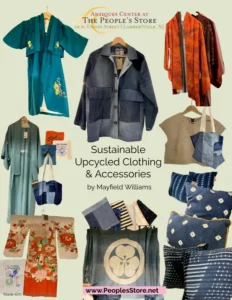
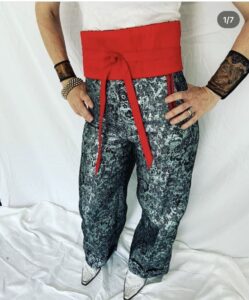
Discover handmade clothing, handbags, pillows, potholders, and accessories from Lambertville designer Mayfield Williams. Each piece is crafted from vintage Japanese textiles, boro-inspired materials, African mud cloth, and recycled denim and canvas.
Additionally, you will find a stunning selection of vintage Japanese kimonos.
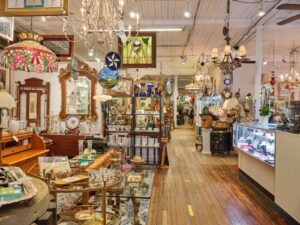
Mayfield’s showroom is located on the lower level.
Special thanks to Thom Reaves, Publisher of Studio Tour Magazine, for granting permission to repost this magnificent article. Enjoy the read!
P.S. Personal Style: Mayfield Williams, Creating an aesthetic beyond fashion

STM: I was introduced to Mayfield Williams by a close friend who is also a close friend of hers. We met over coffee and croissants and had a most enlightening discussion on work, design, fashion, and a myriad of other subjects. I never expected to become so fascinated over what she creates; so, I asked, and to my delight, she agreed to an interview.
STM; Mayfield, Williams, it’s such a pleasure to have you with us for Studio Tour Magazine’s PS Personal Style! I hope these questions give you a chance to let our readers know who you are, what you and your work are all about and how we can all lead the creative life.
How do you view your creative process as a holistic expression of art that transcends different mediums?
MW: I think I approach most visual things from an aesthetic perspective…I pretty much look at all things and evaluate their color, texture, size, etc. this includes roads, buildings, airports or the way everyday objects are casually placed ( or tossed) around the house, the way food looks in a pan while I’m cooking it.
Some things I choose to act on (like the way the furniture is arranged in the house), some things I leave alone (like cooking the food) and some things I just fantasize about changing (like free roads and bridges). I spend some of my free time drawing or working out designs on the computer re-designing my neighborhood. This is pleasurable for me, equivalent to watching Television or playing video games
STM: How does your work, whether it be wearable art, photography, or accessories, shape and influence the daily lives of your clients or collectors?
MW: Ha! I hope it brings them pleasure. I hope they feel good wearing the things I make or enjoy having the objects around their homes.
STM: In what ways do you see your art as a reflection of personal identity and self-expression for those who engage with it?
MW: Answer: Because I live in a culture that allows for personal expression, I imagine that the people who wear the things I make are engaged in personal expression. I have an idea what I am trying to express with the things I make, but people use the things in their own way. It is rare that I meet someone who has an aesthetic that is terribly similar to mine. I am just happy that people buy what I make.
STM: How does the versatility in your work—from fine art to fabric design—mirror the idea that art is integrated into every aspect of life?
MW: The art is already there. It is there to be seen. I just happen to be able to make many things. The skill to make allows one to fantasize about what to make. The more you know, the more you can do. I am just fortunate to be able to work in many disciplines. Because I have a wide “skill” net, I appear to be integrating art in all aspects of my life. I wish I knew more. Sometimes I feel frustrated by wanting to make things for which I lack the training. When I feel like that, I will make a “substitute “piece. For example, I like architecture and buildings, but I don’t know how to build a building, so instead I will do architectural drawings, I can draw. Or I will build a model of a structure, I can do that. When I make these things, I often feel satisfied.
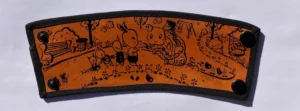
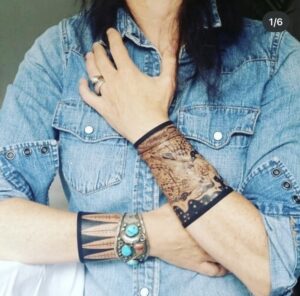
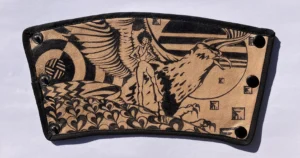
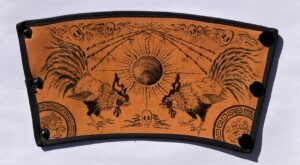
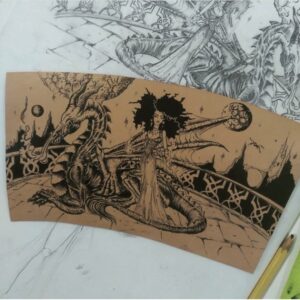
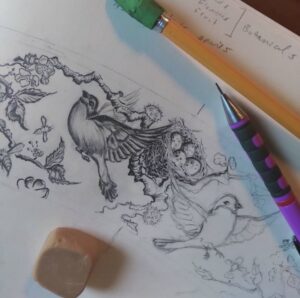
STM: How did you come up with this idea for the cuffs?:
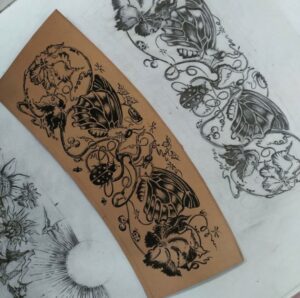
MW: As a youth Tattoos were in the realm of sailors, prisoners or Yakuza. However, they were just starting to push out into the world of the everyday person in the early 90’s. As one might expect, trends emerge in fringe spaces and artists often occupy those spaces.
As an art student I could watch this trend emerge amongst my fellows.
I happened to be in the Jewelry department of the now defunct “University of the Arts”, so conversation about body adornment was a daily occurrence.
Tattoos were appearing on the students, and they were different from the imagery associated with groups that inspired them. The images were quirky, some were geometric, some of the images reflected some of the aesthetic of the 90’s; abject, Victorian, dark.
I had a classmate in the jewelry department that had tattoo around her wrist. It was designed like a patterned bracelet, a repeating pattern. I liked it. It wasn’t a picture or a story. I think that’s what I liked about it. It looked like jewelry that was drawn on her.
It was a melding of what we as jewelry students made everyday and this other artform that was gaining popularity.
I was also interested in leather. I would frequently work with leather as a jewelry material. I can’t really remember the next phase of development for me. But it was obviously putting the two concepts together. I made my first cuff about 21 years ago, maybe 2002.
I don’t have any tattoos, but I do wear my cuffs frequently.
STM: Can you share how your clothing and accessories embody the philosophy of “Art as Lifestyle”? How do they go beyond fashion to become a way of living?
MW: If one accepts that visual art is communicating through images without words, then I imagine that the clothing and accessories one wears are communicating something about the wearer. The body becomes a walking canvas; how will one adorn it? In this culture one has many choices about the “image” one will put forward.
But, back to the artistry here; putting together an outfit is like putting together a painting, sculpture or a room. What shapes and colors will there be? What is the concept being projected, etc. Maybe someone is wearing a uniform, the uniform non-verbally communicates something about the wearer. Even a basic outfit is still communicating. Maybe someone is being innocuous or going unnoticed with their wardrobe, this is just as constructed and considered as an outlandish outfit. Wardrobe is a great place to start when thinking about art in ones life; most of us are getting dressed everyday.
STM: How do you approach the relationship between form and function in your creations, especially when designing wearable or usable art?
MW: I love thinking about form and function! Solving for this is like a fun game, a puzzle, a Rubik’s cube. The question is how to maintain a desirable form that still functions. That is the Dilemma. For example, what good is belt buckle that is so heavy it pulls your pants down? The form is a belt buckle, its function is to clasp the strap that is holding your pants up. Even more is the idea of ornamenting or altering the buckle in such a way that it no longer functions. It is a delightful puzzle.
STM: What role does cultural engagement and storytelling play in your designs, and how do you think this resonates with the concept of art as a lifestyle?
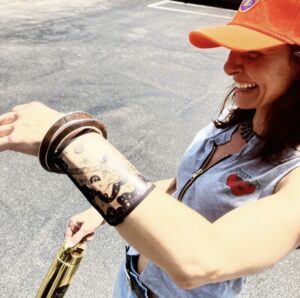
MW: I derive great pleasure from stories, I suppose I am assuming that other people do too…of course they do, television wouldn’t be so popular if people didn’t like stories. I often weave some references to well known stories (like fairy tales) into my artworks, it is a way of communicating a specific idea, but it’s also a way of connecting with an audience; the audience would know the the story too. That common piece of information is way for them to relate to the artwork.
STM: How do you think your eclectic range of work encourages individuals to live creatively and make intentional choices about how they surround themselves with art?
MW: Just opening oneself up to the possibility that the opportunity to be creative is all around you is a notion that I might take for granted. One must allow the mind to entertain the idea of exerting an aesthetic action onto its surroundings. I think one would have to ask oneself, “Am I inspired by how something outside of myself looks? Do I want to accomplish that in my own surroundings? Can I do it? What skills do I need? Is there a way I can play or experiment with the inspiration? Why am I motivated to direct my energy in this way?”
STM: What does the idea of “aesthetic living” mean to you, and how do your pieces, from photography to accessories, contribute to that vision?
MW: For me, this means taking aesthetics into consideration in my surroundings, wardrobe and presentations. This could be how my yard looks, how the furniture is arranged, etc. I often can’t control what’s around me, like streets and strip malls, but I still think about them. I wonder at moving through spaces that seem ugly to me, uninviting. I like to ponder improving them. I enjoy thinking about aesthetics. I mentioned this earlier, there is a kind of pleasure in the problem solving. I like to ask myself questions about the projects I am working on, like what would make it better and why? Why is one thing an improvement and another not? What is the purpose of object or space? I am imagining as I ask this question a specific example like parking lot: the shape of the lot, are there trees? lights? What kind of lights? power lines? Are these things attractive? Could they be arranged or manipulated to be pleasing?
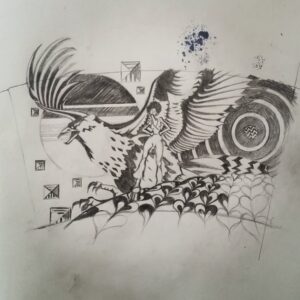
STM: Can you explain how your photography captures moments of artistic living, and how it reflects a deeper connection to lifestyle?
MW: I have two types of photography; one is very staged and controlled and requires a lot of effort and time. I usually plan it out and make costumes and sets. The other kind is more casual, this would be Pictures for social media. These are pictures to present my work and occasionally pictures from my surroundings that create a kind of aesthetic oeuvre that contributes to the look of “look” of the business. For these pictures I think about color and composition and how the images relate to my social media presentation. I use social media for my business, it is not for my personal life. I suspect that social media and apps like Instagram can give everyone the opportunity to think about artistic principles. This second type is harder for me, I am not a natural photographer, I must put more effort into it than some other things.
STM: How do you see the integration of different art forms in your work contributing to a lifestyle that prioritizes creativity, beauty, and individuality?
MW: Hmmmmmmmm, it is integrating all the different forms. Being able to see them everywhere. Being a maker (as any maker) puts these considerations up front. Being able to make things in different mediums puts them all up front in the mind. The disadvantage of this is I am a generalist, not a specialist.
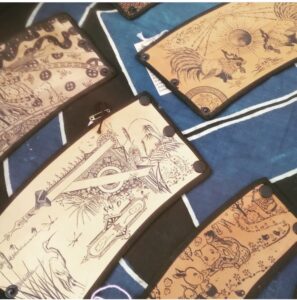
STM: In your view, what role do wearable and useable art pieces play in helping individuals curate a lifestyle that is centered around artistic values?
ME: Most people have functional objects in their lives, clothing, plates, bedspreads, etc. I am making a distinction here between Fine art and Craft, most people have craft in their lives and understand its purpose. No one has to explain what a mug is, or what pants are. The next step is to see these objects that many of us own and have access to (enter Mass production makes things affordable and accessible) as carrying a message. Does it carry a message? Can i use it to carry a message? If I wear Black pants versus red pants does that mean something? It could if I want it to. Sometimes intention is there and sometimes it’s not. Some things are just function. But, anyway, if one chooses to play with these forms, they can be used to create art in your everyday life.
STM: How do you balance the diverse mediums you work in while maintaining a cohesive artistic vision that speaks to your audience?
MW: That one is easy! I think an aesthetic can be be translated across many different mediums with ease. Its just using the same shapes, colors, textures, and patterns and applying them to different forms.
STM: In what ways does your art challenge traditional boundaries between high art and everyday design, making art more accessible as a lifestyle?
MW: The most obvious distinction is function. Craft has a utilitarian purpose. Craft is part of the lifestyle landscape. Craft exits first to be useful; it is a tool. But, the more one thinks about it, the more Complex and layered it can become. Various “meanings” can be applied to the utilitarian objects through imagery and form or use. Ritual objects have this. Jewelry is rife with this. An example is a ring: there is a graduation ring and then there is a wedding ring; both rings, but vastly different meanings. Clothing can be like this too. Special garments with special meanings. It goes on and on; goblet, vase, throne, shroud, etc.
I am curious about how we people invest objects with meaning, I am most curious about sentimental attachments like quilts a great grandmother made, or a cradle a great grandfather made…
STM: How do you see your work contributing to or shaping the culture of “art as lifestyle” that blends aesthetics with practical, daily use?
MW: I think my work can serve as an example. I think coming from a craft background (I started out as a jeweler) helps. Craft is an easy way into seeing objects around you as aesthetic contributions to your surroundings.
STM: What inspires you to work across such a diverse range of mediums, and how do you see this diversity enriching the lives of those who engage with your work?
MW: Ha! I can’t help myself. I just started acquiring skills, this could be a symptom of an undisciplined mind coupled with curiosity. Some of it was that, and some it is life just thrusting itself upon me or anyone. I am definitely open to learning skills, especially if I see them as having artistic potential. I love being able to make what I am thinking about. I am also not afraid to experiment. What that really means is, I am okay with failing and trying again. Making things is very messy and full of errors.
STM: How do you envision the people who wear or use your designs experiencing their daily lives differently because of your artistic influence?
MW: Well, for me personally, I have a few objects in my life that I just love to be around and use. I have a dish rag/ towel that brings a little pulse of pleasure every time I use it or see it. I love everything about it; the color, the texture, and the pattern. I suppose it is perfect. Such a simple thing. I am just trying to make more of those, more perfect things, and hoping that what I make brings others equal joy. I fully accept that most of the time I am failing at this, but I like having a goal.

STM: In what ways do you hope your work encourages a more mindful and artful way of living, from the spaces people inhabit to the clothes they wear?
MW: I hope it makes people excited about the creativity they inherently posses. Especially clothing, everyone gets dressed in the morning, why not start there? It is an opportunity to think about color, shape, and texture. People are already doing this, just may not have named it. It’s engaging in artistry. The naming it makes one more of aware of it as an occurrence.
STM: How do you ensure that the craftsmanship and artistic intent in each piece stays at the forefront, regardless of whether it is fine art or a functional accessory?
MW: I am very concerned with craftsmanship. I want my pieces to be reliable in their wearability and functionality. I am not in an economic or temporal position to deal with repairs and maintenance. I construct my pieces to last within the current expected time frames of whatever they are. As for artistic intent, this a little harder with the functional pieces, but if one begins with the shape in mind, it is a little easier.
My work is fairly traditional, so this makes it easier too. Meaning I work in a sphere where there is plenty of art that came before me that I can refer too. I am not tackling some contemporary art problems that can disrupt issues of craftsmanship and intent.
STM: Can you share an example of how one of your pieces—whether a photograph or a fabric design—has transformed a client’s sense of connection to their own lifestyle or identity?
MW: Yes. I do not know if my pieces have transformed anyone’s thinking, but I definitely think my pieces enhance a person’s already existing personal aesthetic or an image they want to project.
STM: Mayfield, wonderful interview and time with you! Thank you for taking the time to speak with us at Studio Tour Magazine.
MW: Thank you for the questions, they were quite challenging.

Link to Studio Tour Magazine:
Studio Tour Magazine | Online art magazine
Link to their article
STUDIO TOUR MAGAZINE:
P.S. Personal Style: Mayfield Williams, Creating an aesthetic beyond fashion
You can follow Mayfield on Instagram
@mayfield_at_1000autumns
@mayfield_at_1000autumns, #antiques, #peoplesstoreantiquescenter, #lambertvilleantiques, #lambertvilleantiquing, #designerclothing, #lambertvillefashion, #mayfieldat1000autumns,
#designerfashion, #customclothing, #repurposedclothing, #reusedclothing, #upcycleclothing, #painterstarpclothing, #paintertarpclothing, #tsutsugaki